Ean Canfield
3D printed PETG tensile DOE
Lean Six Sigma Green Belt project | Spring 2026
Skills
- Design of experiments (Minitab)
- Tensile testing to ASTM D638
- Lean Six Sigma (DMAIC)
Overview
Raster angle and material mattered most; yield strength barely moved. For my Lean Six Sigma Green Belt project, our four-person team ran a design of experiments to find out which print settings change the tensile properties of 3D printed PETG. I designed the half-fraction factorial experiment in Minitab, and we printed, pulled and analyzed twelve specimens.
Experiment design
Four factors at two levels each would take sixteen runs as a full factorial. A half-fraction design covers the same factors in eight, and we added four center-point runs to check for curvature, for twelve specimens in total.
- Extruder temperature: 230 °C or 260 °C
- Raster angle: 0° or 90°
- Extruder speed: 100 mm/s or 140 mm/s
- Material: standard PETG or carbon-filled PETG
The center points sat at 245 °C, 45° and 120 mm/s, two in each material.
Testing
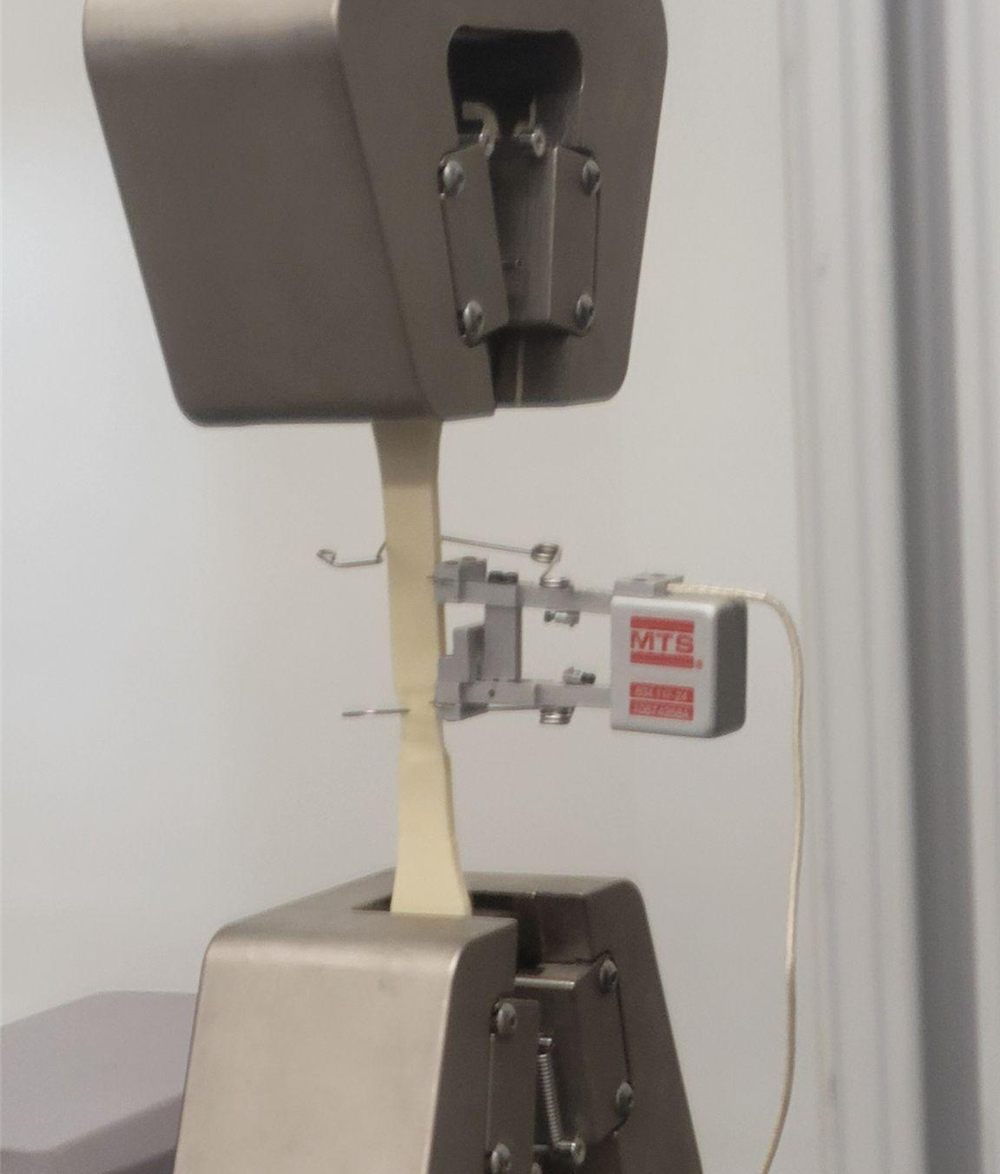
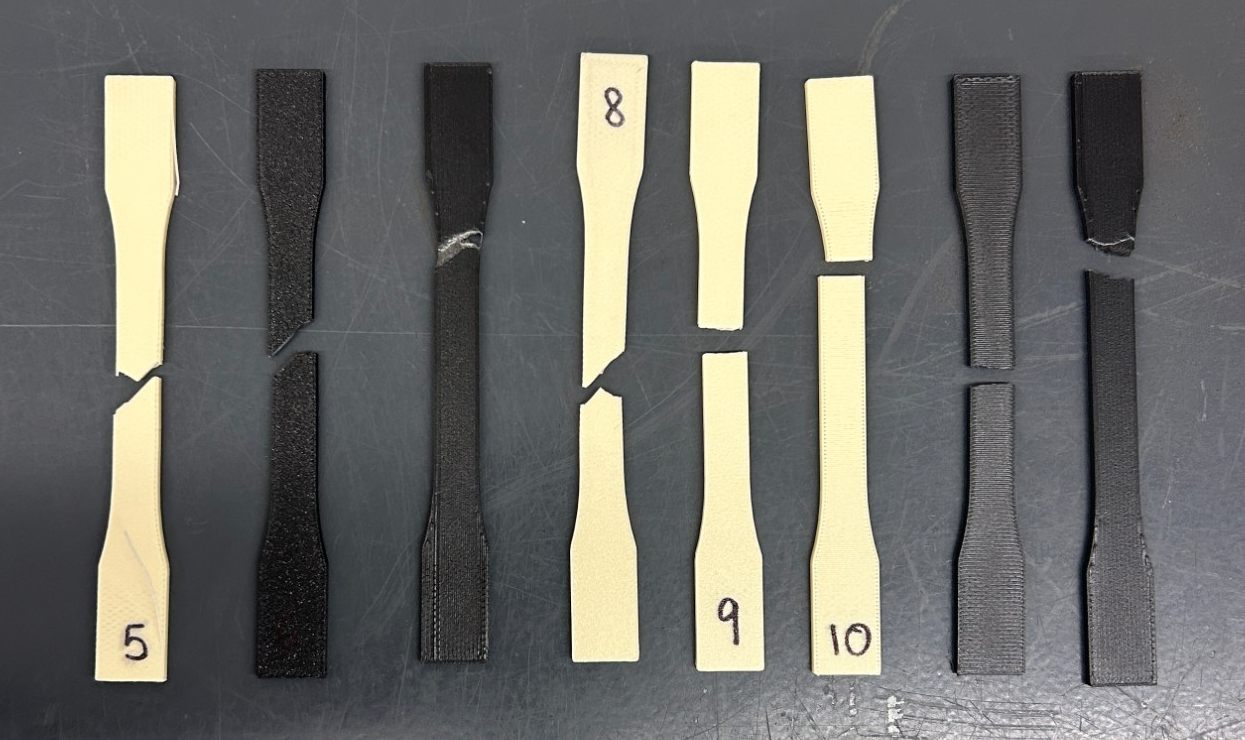
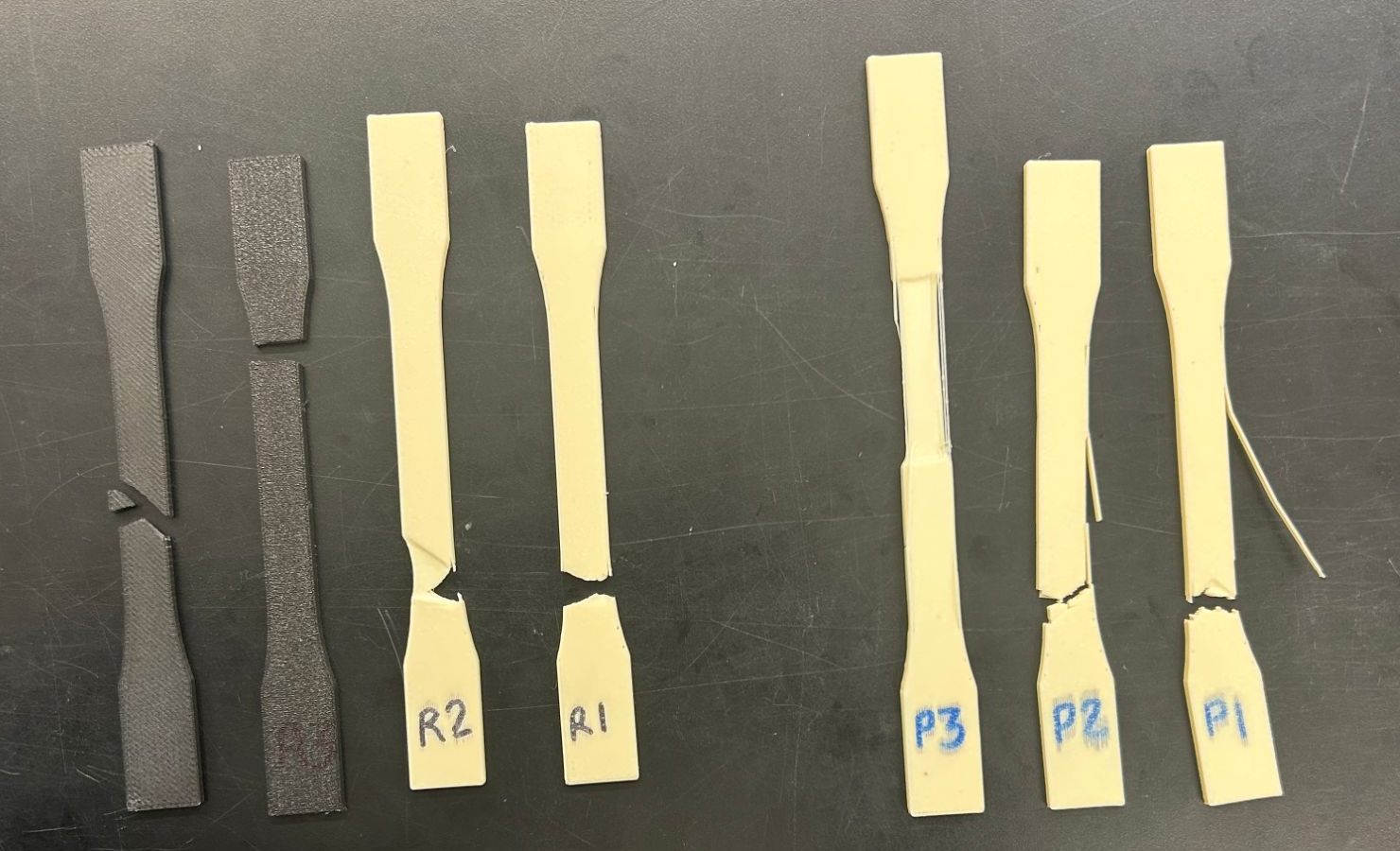
The specimens followed the ASTM D638 geometry, modeled in SolidWorks and printed on a Bambu Lab P1S. We measured each one’s width and thickness at three points, then pulled it on an MTS Criterion Series 43 load frame with an MTS extensometer attached through yield and removed before failure.
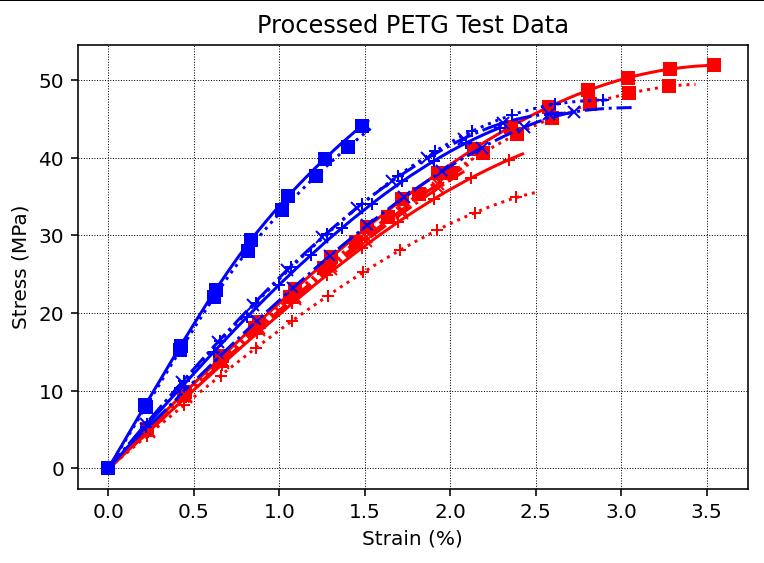
The load frame records force and position over time, so a Python script trimmed the extra data, converted it to stress and strain using each specimen’s measured cross-section, and found the modulus of elasticity, offset yield strength and ultimate strength for each run.
Results
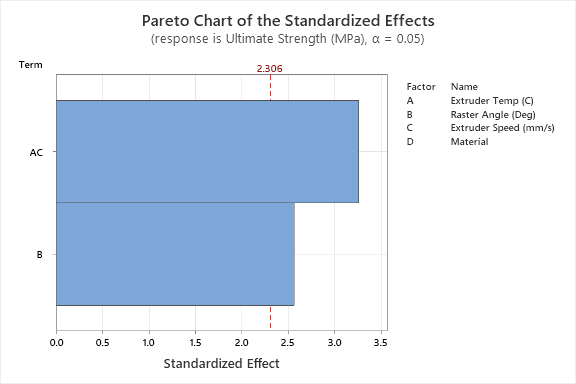
- Ultimate strength ranged from 35.6 to 51.9 MPa. Raster angle and the interaction between extruder temperature and speed were the significant effects. Specimens printed at 0° averaged about 5.5 MPa stronger than those at 90°.
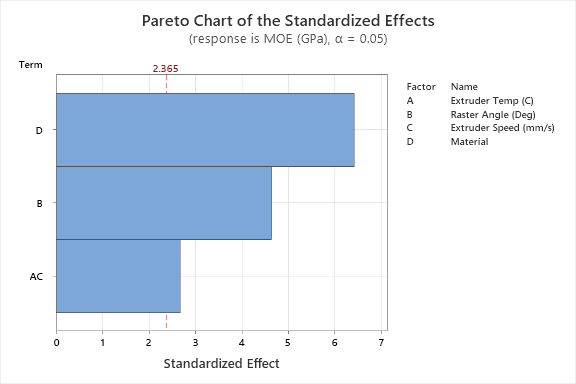
- Stiffness ranged from 1.84 to 3.84 GPa. Material and raster angle were the significant effects: carbon-filled PETG was stiffer than standard, and 0° was stiffer than 90°.
- Offset yield strength showed no significant effect from any of the four factors.
Significance was judged at α = 0.05 from the Pareto charts of standardized effects in Minitab.
Run data
| Temp (°C) | Raster | Speed (mm/s) | Material | Yield (MPa) | Modulus (GPa) | Ultimate (MPa) |
|---|---|---|---|---|---|---|
| 230 | 0° | 100 | Standard | 37.2 | 2.14 | 49.4 |
| 260 | 0° | 140 | Standard | 33.7 | 2.30 | 51.9 |
| 230 | 90° | 100 | Carbon filled | 35.9 | 2.59 | 47.4 |
| 245 | 45° | 120 | Carbon filled | 34.5 | 2.65 | 45.8 |
| 245 | 45° | 120 | Standard | 40.7 | 1.94 | 38.6 |
| 245 | 45° | 120 | Carbon filled | 35.6 | 2.21 | 46.4 |
| 260 | 0° | 100 | Carbon filled | 38.5 | 3.84 | 44.4 |
| 245 | 45° | 120 | Standard | 40.7 | 1.97 | 39.1 |
| 260 | 90° | 100 | Standard | 37.4 | 1.95 | 40.5 |
| 230 | 90° | 140 | Standard | 29.5 | 1.84 | 35.6 |
| 260 | 90° | 140 | Carbon filled | 35.1 | 2.44 | 43.9 |
| 230 | 0° | 140 | Carbon filled | 39.3 | 3.61 | 43.9 |
Project images